
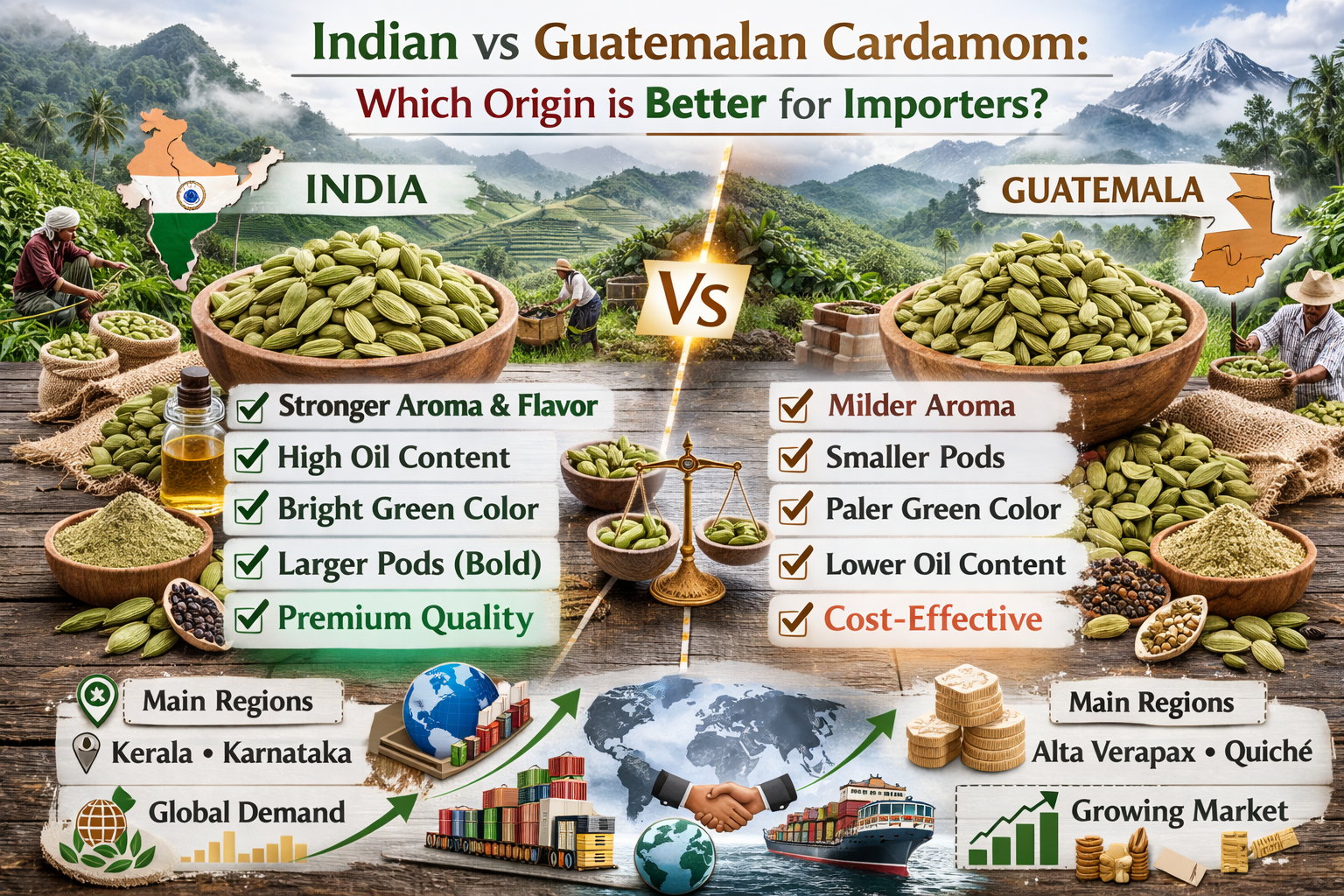
The global cardamom trade is largely shaped by two dominant origins: India and Guatemala. Together, these countries account for the majority of international supply, yet their positioning in the market differs significantly.
For international importers, choosing between Indian and Guatemalan cardamom is not simply a pricing decision — it is a strategic sourcing choice that affects product performance, brand positioning, and long-term profitability.
Understanding the structural differences between these two origins allows buyers to align procurement strategy with their target market.
Production Scale vs. Premium Differentiation
Guatemala leads the world in cardamom production volume. Large-scale cultivation enables the country to supply substantial quantities to global markets, particularly in the Middle East.
Its competitive advantages include:
- High production capacity
- Strong supply consistency in bulk volumes
- Competitive pricing structures
- Established export routes
However, production scale does not automatically translate into premium differentiation.
India, while producing comparatively lower total volumes, holds a strong reputation in premium market segments. Indian cardamom — especially from high-altitude Western Ghats regions — is known for:
- Stronger aroma intensity
- Higher volatile oil concentration
- Dense capsule structure
- Vibrant natural green color
These characteristics make Indian-origin cardamom particularly attractive for buyers targeting premium retail and specialty food sectors.
Oil Concentration & Aroma Performance
One of the most critical technical differentiators between Indian and Guatemalan cardamom is volatile oil content.
High-altitude cultivation in India enhances essential oil development due to:
- Cooler mountain temperatures
- Rich organic soils
- Balanced rainfall patterns
- Shade-grown agroforestry systems
Higher oil concentration directly impacts:
- Flavor depth
- Aroma intensity
- Shelf-life stability
- Performance in processed foods
For premium tea blends, gourmet spice packaging, coffee infusions, and luxury culinary applications, stronger aroma performance significantly influences purchasing preference.
Guatemalan cardamom, while suitable for bulk distribution, may present comparatively lower oil retention in certain grades.
Visual Appeal & Color Retention
Visual presentation plays a major role in retail markets.
Indian cardamom is widely recognized for:
- Naturally vibrant green color
- Uniform capsule shape
- Dense seed formation
Proper curing techniques in India help preserve color without chemical enhancement. For supermarket shelves and high-end packaging, this aesthetic consistency strengthens brand positioning.
Guatemalan cardamom often serves well in ground spice applications and mass-market distribution channels where visual capsule presentation is less critical.
Grading Precision & Quality Inspection
Another key differentiator lies in grading discipline.
Indian exporters typically emphasize:
- Strict size classification (6mm, 7mm, 8mm+)
- Mechanical sorting combined with manual inspection
- Batch consistency verification
- Density evaluation
This grading precision reduces variation between shipments and enhances reliability for importers.
Uniformity is especially important for:
- Retail packaging
- Private-label branding
- Specialty gourmet markets
Fragmented grading systems can create inconsistencies that affect pricing and long-term partnerships.
Structured exporters such as Western Roots Indian Spices integrate grading, curing, and quality control systems to ensure consistent batch performance aligned with international specifications.
Application-Based Decision Making
For B2B importers, the choice between Indian and Guatemalan cardamom depends largely on intended application.
Indian Cardamom – Ideal For:
- Premium retail packaging
- Gourmet spice brands
- Luxury tea and coffee blends
- Specialty culinary markets
- High-end private-label products
Guatemalan Cardamom – Ideal For:
- Cost-sensitive bulk distribution
- Large-volume commodity trade
- Industrial processing
- Price-driven wholesale markets
Each origin serves a distinct segment within the global trade ecosystem.
Pricing vs. Performance
Guatemala’s production scale often allows competitive pricing in volume-driven markets. Importers serving mass-distribution channels may prioritize cost efficiency over premium differentiation.
However, buyers targeting brand-conscious consumers often prioritize:
- Aroma strength
- Shelf-life stability
- Visual appeal
- Grade uniformity
In these segments, performance outweighs marginal price differences.
Premium positioning often translates into higher resale margins, making Indian cardamom attractive despite a higher procurement cost.
Supply Chain Infrastructure & Compliance
India benefits from a structured export ecosystem supported by:
- Regulatory authorities
- Phytosanitary certification systems
- Laboratory testing infrastructure
- Established freight networks
This framework strengthens buyer confidence and simplifies compliance in regulated markets such as the EU and North America.
Exporters operating within structured compliance systems reduce regulatory risk and enhance documentation reliability.
Strategic Conclusion for Importers
Choosing between Indian and Guatemalan cardamom should not be framed as “which is better” universally. Instead, the correct question is:
Which origin aligns best with your target market and brand strategy?
If your priority is:
- Competitive bulk pricing
- High-volume commodity distribution
Guatemalan supply may suit your needs.
If your objective is:
- Premium retail positioning
- Strong aroma performance
- Consistent grading
- Brand differentiation
Indian-origin cardamom provides measurable advantages.
For importers seeking premium-grade supply backed by structured export systems, partners such as Western Roots Indian Spices offer integrated sourcing, grading, and compliance management tailored to international market requirements.
Final Insight
Global cardamom trade thrives on diversity of origin. Both India and Guatemala play vital roles in the supply ecosystem. However, when market positioning demands high oil concentration, vibrant color retention, and grade precision, Indian cardamom remains a preferred choice among quality-focused importers.
Understanding origin differences allows buyers to optimize procurement strategy, protect brand value, and align supply decisions with long-term market objectives.