
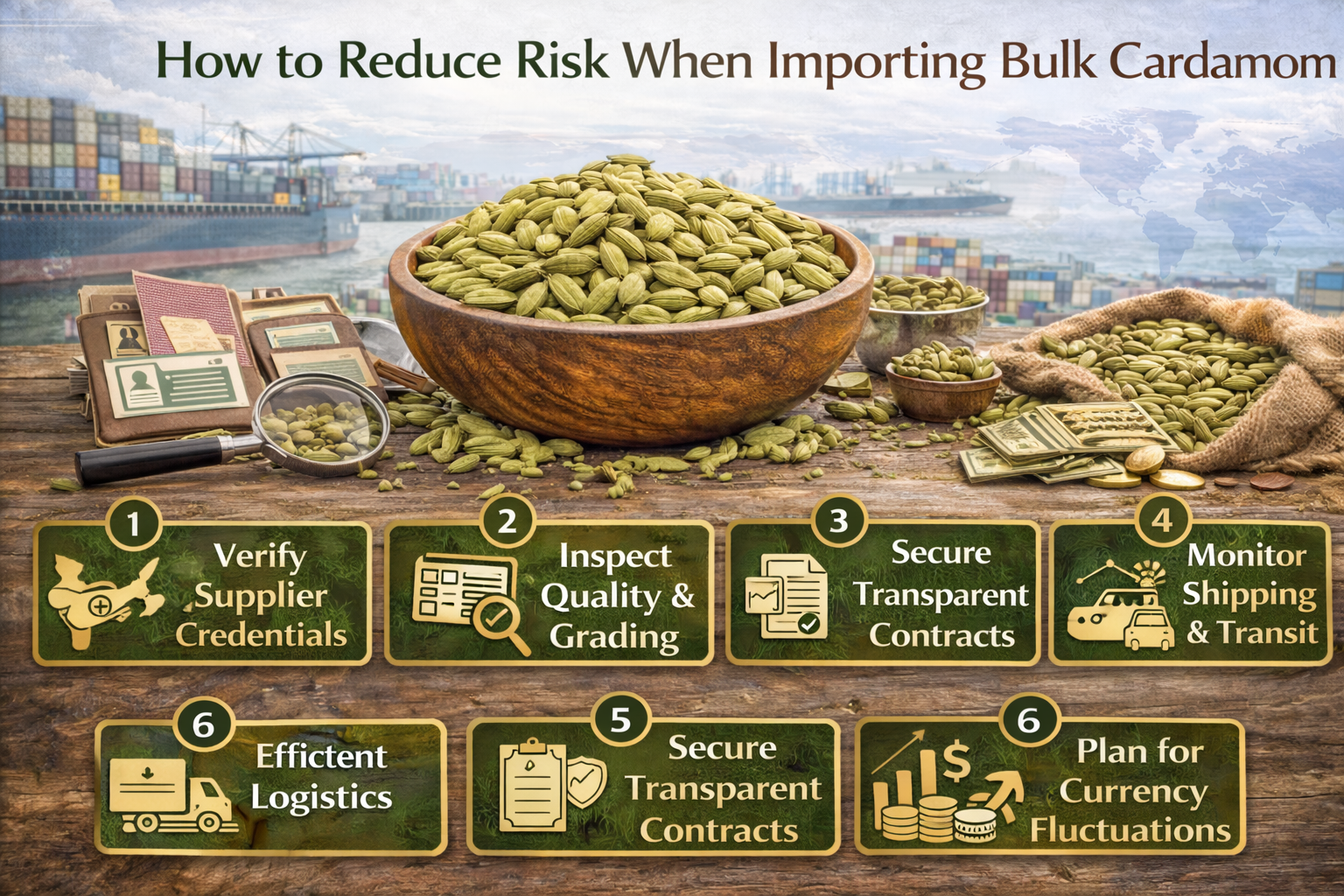
Importing bulk cardamom is a high-value procurement decision that requires careful planning and structured risk management. While global spice trade offers strong profitability opportunities, it also carries operational risks — including quality deviation, moisture imbalance, shipment delays, documentation discrepancies, and regulatory non-compliance.
Professional importers understand that successful bulk procurement is not based on price alone. It is built on due diligence, supplier evaluation, and structured verification processes.
Below are key strategies international buyers should implement to reduce risk when importing bulk cardamom.
1. Request Pre-Shipment Samples
Before confirming large-volume contracts, always request representative physical samples. A sample review should evaluate:
- Aroma intensity
- Capsule size uniformity
- Green color retention
- Density and seed formation
- Absence of foreign matter
Sensory evaluation is the first line of quality control. Even when laboratory reports are available, physical inspection provides practical validation.
For large contracts, some importers request pre-shipment approval samples from the exact batch being dispatched to avoid discrepancies.
2. Verify Oil Content & Moisture Reports
Cardamom’s commercial value is closely tied to volatile oil percentage and moisture balance.
Laboratory analysis protects buyers from:
- Weak aroma strength
- Shelf-life instability
- Mold formation during transit
- Shipment rejection due to contamination
Excess moisture is particularly dangerous during long sea freight routes, where humidity changes inside containers can cause condensation damage.
Importers should request certified lab reports confirming:
- Moisture percentage
- Oil content
- Purity levels
- Absence of pesticide residues (if required by destination country)
Verification minimizes post-arrival disputes.
3. Confirm Incoterms Clearly
Misunderstanding Incoterms is a common cause of trade disputes. Buyers must clearly define responsibilities under agreements such as:
- FOB (Free On Board)
- CFR (Cost and Freight)
- CIF (Cost, Insurance, and Freight)
Each term determines:
- Who arranges freight
- Who pays insurance
- Where risk transfers
- Responsibility for port clearance
Clarity in Incoterms protects buyers from unexpected charges or liability confusion.
4. Review Export Documentation Structure
Incomplete or inaccurate documentation can delay customs clearance and increase demurrage costs.
A professional export shipment should include:
- Proforma Invoice
- Commercial Invoice
- Packing List
- Certificate of Origin
- Phytosanitary Certificate
- Bill of Lading or Airway Bill
Ensure documentation matches product specifications precisely. Even minor discrepancies in weight or description may cause regulatory complications.
5. Inspect Packaging Integrity
Packaging plays a critical role in protecting cardamom during international transit.
For bulk shipments, buyers should verify:
- Use of moisture-resistant liners
- Multi-layer laminated sacks
- HDPE woven bags
- Proper sealing methods
- Desiccant placement inside containers (if required)
Inadequate packaging increases risk of aroma loss, color fading, and spoilage.
Professional exporters prioritize packaging quality to maintain product integrity across extended shipping cycles.
6. Lock Pricing Strategically
Cardamom pricing is influenced by:
- Seasonal harvest cycles
- Weather conditions
- Global demand patterns
- Production output forecasts
Entering contracts during stable harvest periods reduces exposure to price volatility. Buyers monitoring crop reports and market signals can negotiate more favorable long-term pricing.
Forward contracts also provide predictability in budgeting and retail planning.
7. Partner with Established Exporters
Perhaps the most important risk-reduction strategy is selecting experienced exporters with structured compliance systems.
Established exporters offer:
- Integrated sourcing networks
- Controlled curing processes
- Professional grading infrastructure
- Documentation accuracy
- Freight coordination expertise
- Post-shipment support
Working with organized suppliers reduces the likelihood of compliance errors and shipment delays.
Companies such as Western Roots Indian Spices operate within a structured export framework that combines plantation-level sourcing, grading precision, curing control, and documentation management tailored to international standards.
Additional Risk Mitigation Strategies
Beyond the core steps above, importers can further reduce risk by:
- Conducting supplier background checks
- Verifying trade references
- Reviewing past export markets
- Maintaining clear written contracts
- Implementing inspection protocols before loading
Building long-term partnerships rather than transactional relationships significantly lowers supply uncertainty.
The Importance of Structured Procurement
Bulk spice procurement should be managed through standardized internal procedures. Risk management is not only about preventing product defects — it is about protecting:
- Brand reputation
- Regulatory compliance
- Working capital
- Customer trust
In competitive food markets, even a single rejected shipment can disrupt distribution cycles and damage retailer relationships.
Structured procurement ensures stability and operational confidence.
Conclusion
Reducing risk when importing bulk cardamom requires a disciplined, multi-layered approach — combining quality verification, documentation accuracy, packaging inspection, pricing strategy, and supplier evaluation.
Successful importers understand that risk management in spice trade extends beyond product characteristics. It depends heavily on choosing a reliable export partner who understands international compliance, logistics coordination, and long-term quality consistency.
By implementing structured procurement policies and partnering with organized exporters, global buyers can significantly reduce rejection rates, shipment loss, and brand damage — ensuring sustainable profitability in the competitive cardamom market.