
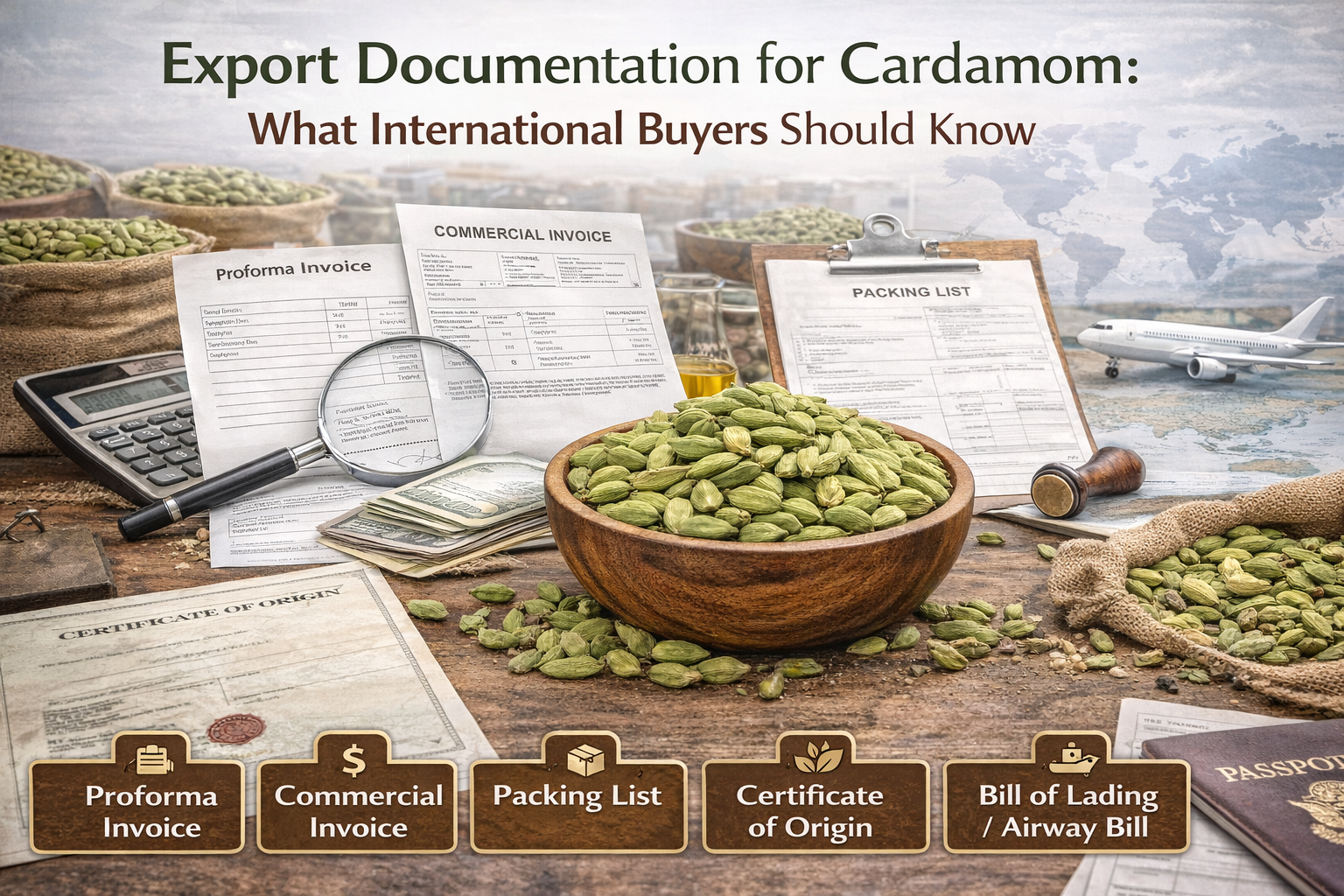
International spice trade is built not only on product quality but also on documentation accuracy. For global importers sourcing Indian cardamom, understanding export paperwork is essential to avoid customs delays, regulatory penalties, and shipment disruptions. In competitive markets, documentation efficiency directly impacts supply chain reliability.
When importing cardamom from India, buyers must ensure that every stage — from proforma confirmation to final shipment clearance — is handled with compliance and precision.
1. The Export Process Begins with a Proforma Invoice
The export cycle typically starts with a Proforma Invoice (PI). This preliminary document outlines:
- Product specifications (size grade, variant, quality)
- Quantity (bulk weight or packaging format)
- Unit pricing and total value
- Agreed Incoterms (FOB, CIF, CFR, etc.)
- Payment terms
- Estimated dispatch timeline
Once the buyer reviews and approves the PI, and the agreed advance payment is received, production and export preparation begin. Accuracy at this stage prevents later disputes and ensures alignment between buyer expectations and supplier commitments.
2. Core Export Documents Required for Cardamom Shipments
A professional export shipment of cardamom includes several mandatory documents. These are not optional — they are essential for international clearance.
Commercial Invoice
The final invoice issued after shipment confirmation. It includes the total transaction value, HS code, shipment details, and payment terms. Customs authorities rely on this for duty assessment.
Packing List
Specifies packaging details including number of cartons or bags, gross and net weights, dimensions, and batch references. This document helps customs and freight agents verify physical cargo against paperwork.
Certificate of Origin
Confirms that the product originates from India. Certain trade agreements may offer preferential tariff benefits depending on the importing country. Buyers in regions with bilateral trade agreements should verify eligibility for reduced duties.
Phytosanitary Certificate
This is one of the most critical documents in agricultural trade. Issued by plant quarantine authorities, it certifies that the cardamom shipment is free from pests, disease, and contamination. Most importing countries require this before permitting entry.
Bill of Lading (Sea Freight) or Airway Bill (Air Freight)
These are transport documents issued by the carrier. They confirm cargo loading and act as proof of shipment. The Bill of Lading also functions as a negotiable document in international trade.
3. Laboratory Reports & Food Safety Compliance
For markets such as Europe, North America, and certain GCC countries, additional testing may be required. Importers often request:
- Moisture content analysis
- Volatile oil percentage report
- Pesticide residue testing
- Microbial load analysis
- Heavy metal screening
These laboratory reports confirm compliance with international food safety standards and protect buyers from regulatory rejection. In highly regulated markets, failure to provide complete documentation can result in cargo detention or destruction.
4. Understanding Incoterms: FOB, CIF, CFR Explained
Incoterms define responsibility between buyer and seller. Choosing the correct term affects freight cost, insurance coverage, and risk transfer.
FOB (Free On Board)
The seller is responsible until goods are loaded onto the vessel. The buyer handles freight and insurance thereafter.
CFR (Cost and Freight)
The seller pays freight to the destination port, but risk transfers once goods are loaded.
CIF (Cost, Insurance, and Freight)
The seller covers freight and insurance up to the destination port.
Understanding these terms ensures clarity in liability, shipping coordination, and risk allocation.
5. Container Handling, Fumigation & Compliance
Cardamom shipments may require:
- Container fumigation (if mandated by destination regulations)
- Moisture barrier lining
- Palletization
- Proper container ventilation
- Desiccant placement to control humidity
Improper container preparation can cause condensation damage during long sea freight routes. Professional exporters monitor loading procedures to prevent spoilage and ensure shipment integrity.
6. Customs Coordination & Freight Management
Beyond documentation creation, coordination is equally important. Exporters must liaise with:
- Customs clearance agents
- Freight forwarders
- Shipping lines
- Inspection authorities
Timely submission of documentation prevents port congestion penalties and demurrage charges. Experienced exporters pre-verify paperwork before container departure, reducing clearance uncertainty at destination ports.
At Western Roots Indian Spices, export documentation is managed as an integrated system — ensuring proforma accuracy, regulatory compliance, and freight coordination are aligned before dispatch. This reduces delays and enhances predictability for international buyers.
7. Why Documentation Precision Protects Importers
For global buyers, incomplete or inaccurate documentation can result in:
- Customs delays
- Additional inspection fees
- Duty miscalculations
- Shipment rejection
- Brand reputation damage
Even high-quality cardamom loses value if regulatory compliance is weak. Efficient documentation protects working capital and ensures uninterrupted supply chain flow.
8. Risk Mitigation Through Organized Export Systems
When partnering with structured exporters, buyers benefit from:
- Pre-shipment verification
- Accurate HS code classification
- Regulatory updates on destination requirements
- Clear communication on Incoterm responsibilities
- Transparent payment documentation
Organized export systems reduce business risk and improve long-term trade reliability.
By working with experienced exporters such as Western Roots Indian Spices, importers gain access to professional documentation handling alongside premium-quality cardamom supply.
Conclusion
In global spice commerce, compliance and professionalism are as important as product quality. Understanding export documentation allows buyers to anticipate requirements, plan inventory cycles efficiently, and avoid unexpected port delays.
Efficient paperwork, clear Incoterm agreements, laboratory compliance, and structured freight coordination transform international trade from a risk-prone process into a predictable business operation.