
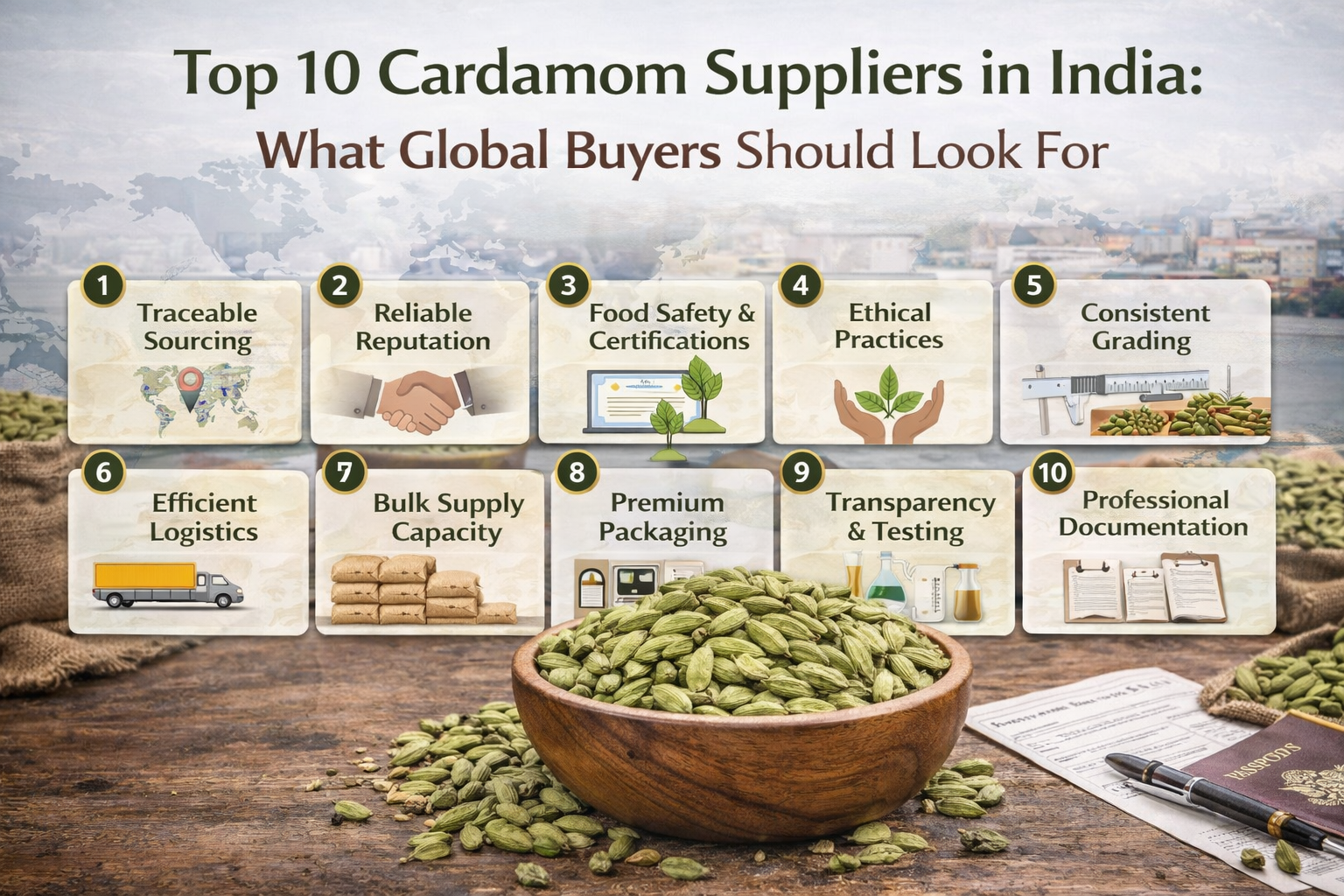
When international buyers search for the top 10 cardamom suppliers in India, the objective is not merely to identify large-volume exporters. The real goal is to partner with reliable, certified, and quality-driven suppliers capable of delivering consistent performance across multiple shipment cycles.
India remains one of the world’s most respected producers of premium green cardamom, particularly from the high-altitude regions of the Western Ghats. However, not all suppliers operate with the same infrastructure, compliance standards, or export discipline. Ranking a supplier requires evaluating measurable operational strengths rather than marketing claims.
Below are the key factors global buyers should assess when selecting among leading cardamom exporters.
1. Origin Authenticity & Plantation Access
Authenticity of origin directly influences product quality. Suppliers sourcing directly from high-altitude plantation zones (800–1500 meters above sea level) typically provide oil-rich, aromatic capsules with superior density and color retention.
Traders sourcing from mixed or secondary markets may struggle with batch inconsistency. Direct plantation relationships indicate better traceability and quality control.
2. Grading Infrastructure & Size Uniformity
Professional exporters maintain structured grading systems capable of delivering uniform size classifications such as:
- 6mm
- 7mm
- 8mm+ bold grades
Mechanical grading combined with manual inspection ensures size consistency and eliminates visual variations. Uniform grading improves retail presentation and packaging efficiency, especially for buyers serving premium markets.
3. Controlled Curing Systems
Post-harvest curing significantly impacts aroma retention and color stability. Advanced electric drying chambers operating at regulated temperatures preserve volatile oil concentration and natural green color.
Improper curing results in faded pods, reduced shelf life, and aroma loss — all of which reduce export value. Suppliers investing in controlled curing technology demonstrate quality commitment.
4. Certification & Regulatory Compliance
Leading suppliers operate within documented compliance frameworks. Buyers should verify the availability of:
- FSSAI registration
- Spices Board certification
- Phytosanitary clearance
- Laboratory analysis reports
- Residue compliance documentation
Certification readiness reduces customs delays and ensures acceptance in regulated markets such as Europe, North America, and GCC countries.
5. Export Documentation Expertise
Professional exporters handle documentation with precision. This includes preparing:
- Proforma Invoice
- Commercial Invoice
- Packing List
- Certificate of Origin
- Bill of Lading or Airway Bill
Documentation accuracy reduces port delays and protects working capital. Suppliers lacking structured export systems may expose buyers to clearance risks.
6. Packaging Capability & Customization
Top cardamom exporters offer flexible packaging solutions including:
- Bulk cartons (25kg / 50kg)
- Moisture-resistant liners
- Vacuum sealing
- Nitrogen flushing (when required)
- Private-label retail packaging
Operational maturity is reflected in packaging adaptability. Suppliers supporting branding and custom requirements are better suited for long-term partnerships.
7. Consistent Supply Capacity & Scalability
Global buyers require scalability. The ability to increase shipment volumes during seasonal demand spikes demonstrates supply strength.
Reliable suppliers maintain stable sourcing networks and processing capacity to meet contract commitments without disruption.
8. Market Reputation & Export Presence
A strong export footprint across GCC, European, North American, and Asian markets indicates credibility. Longevity in international markets reflects operational stability and client trust.
Buyers should review supplier trade history, destination markets, and consistency in shipment cycles.
9. Transparent Pricing Structure
Premium cardamom pricing fluctuates based on grade, oil concentration, and market conditions. Reputable suppliers provide:
- Clear grade-based pricing
- Market-aligned quotations
- Transparent negotiation terms
- Defined Incoterms
Unrealistically low pricing often signals compromised quality or inconsistent grading.
10. Post-Shipment Support & Communication
Shipment dispatch is not the end of the transaction. Leading suppliers provide:
- Real-time shipment tracking
- Prompt document sharing
- Responsive communication
- Assistance with customs queries
Strong post-shipment support reduces operational uncertainty and builds long-term confidence.
Strategic Supplier Selection Matters
Rather than chasing the lowest price, global buyers should prioritize:
- Quality consistency
- Documentation accuracy
- Processing infrastructure
- Compliance readiness
- Communication reliability
A structured evaluation approach allows importers to identify exporters capable of sustaining long-term trade relationships.
Among India’s established exporters, Western Roots Indian Spices represents the type of structured, compliance-focused supplier that international buyers typically seek when evaluating top-performing cardamom exporters.
Conclusion
Searching for the top 10 cardamom suppliers in India is not about compiling a list of company names. It is about identifying suppliers who combine plantation access, grading discipline, curing technology, certification readiness, and export professionalism.
In today’s competitive global spice market, reliable partnership outweighs short-term pricing advantages. Buyers who adopt a systematic evaluation model are more likely to secure consistent supply, protect brand reputation, and strengthen long-term profitability.