Private labeling has evolved into one of the most powerful growth strategies in the global spice industry. Rather than investing heavily in plantation ownership, processing facilities, and export compliance systems, international brands increasingly collaborate with structured Indian exporters to develop premium branded cardamom products under their own identity.
For global retailers, wholesalers, and specialty spice brands, private label partnerships offer control over brand positioning while leveraging the expertise of established origin suppliers.
India’s cardamom sector — particularly from the Western Ghats — provides an ideal foundation for private-label development due to consistent grading standards, export readiness, and packaging flexibility.
Why Private Label Cardamom Is Growing Globally
Global consumer demand for authentic, origin-based spices continues to rise. In markets such as Europe, the Middle East, and North America, buyers increasingly look for:
- Premium green color
- Strong aroma intensity
- Transparent origin labeling
- Clean-label assurance
- Professional packaging
Private labeling allows distributors to capture this demand without operating upstream agricultural infrastructure.
By partnering with experienced exporters, brands can focus on:
- Marketing strategy
- Retail placement
- Distribution expansion
- Brand storytelling
while production, grading, and export logistics remain professionally managed at origin.
Key Advantages of Private Label Cardamom Export
International brands benefit from several operational and commercial advantages:
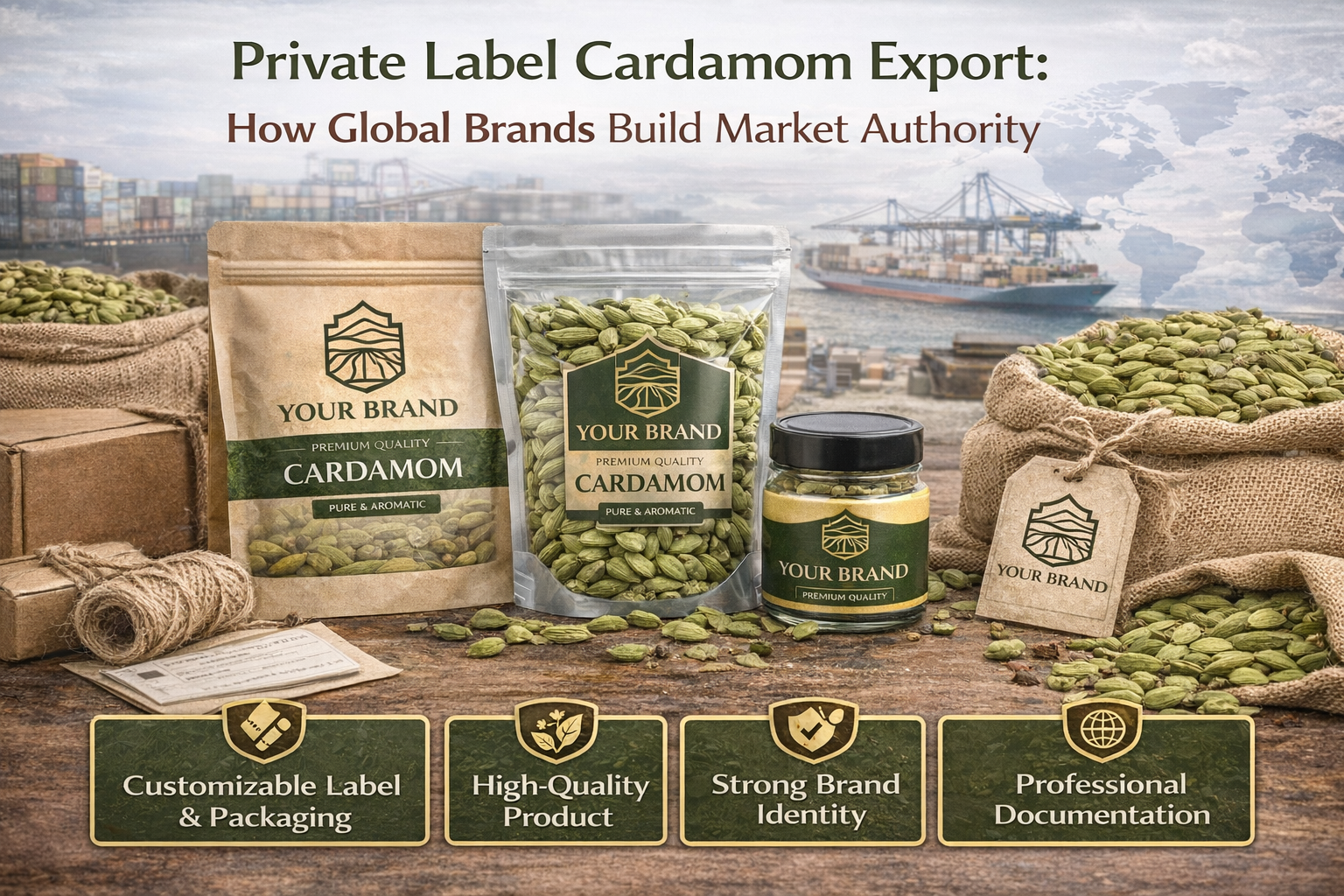
Custom Packaging Design
Private label programs support customized pouches, cartons, and retail formats aligned with brand identity.
Retail-Ready Formats
Stand-up pouches, zip-lock packaging, glass jars, and carton boxes allow shelf-ready presentation without additional repacking.
Multilingual Labeling Compliance
Exporters align packaging with regulatory requirements in EU, GCC, US, and Asian markets — including ingredient declaration, country-of-origin labeling, allergen compliance, and batch traceability.
Bulk-to-Retail Conversion
Importers can procure bulk cardamom and convert it into consumer-ready SKUs through structured packaging support.
Confidentiality Agreements
Professional exporters protect brand integrity through non-disclosure and exclusivity frameworks.
These operational capabilities reduce complexity for global buyers and allow brands to maintain consistent quality standards.
Quality as the Foundation of Brand Authority
Private labeling success begins with product quality. In premium retail segments, visual appeal and aroma strength directly influence consumer perception.
Bold 8mm+ grade capsules with vibrant natural green color create strong shelf presence in supermarkets and gourmet stores. Larger capsule sizes are often associated with premium positioning, especially in Middle Eastern and European retail environments.
However, beyond size, volatile oil concentration determines flavor depth. Retail brands focused on long-term customer loyalty prioritize oil-rich capsules that deliver consistent aroma during grinding and infusion.
Structured exporters with integrated grading and curing systems ensure that private-label batches maintain uniformity — a critical factor for brand reputation.
At Western Roots Indian Spices, private-label programs combine plantation sourcing, grading precision, and export-grade packaging to help brands maintain consistent product identity across markets.
Shelf Life & Packaging Innovation
Cardamom is highly sensitive to moisture and oxidation. For long shipping routes — particularly sea freight to Europe or North America — packaging integrity is crucial.
Professional exporters offer:
- Nitrogen flushing
- Moisture-barrier liners
- Vacuum-sealed bulk bags
- Multi-layer laminated pouches
These technologies extend shelf life, preserve volatile oils, and maintain natural color during transit and retail display.
For brands operating in high-temperature regions, moisture control significantly reduces spoilage risk and protects margins.
Scalable Growth Through Flexible Volumes
One of the most attractive aspects of private labeling is scalability. Emerging brands and mid-sized distributors can:
- Launch pilot SKUs
- Test regional markets
- Expand gradually based on demand
Rather than investing in large fixed inventory, importers can adjust order volumes according to market response. This reduces financial exposure while maintaining supply continuity.
Private label partnerships also support seasonal demand adjustments — particularly during festive periods when cardamom consumption rises sharply.
Regulatory Alignment & Market Access
Private labeling requires strict adherence to destination-country regulations. Exporters must align packaging and documentation with:
- EU food safety regulations
- GCC labeling standards
- US FDA compliance requirements
- Batch coding and traceability rules
Accurate documentation and labeling prevent customs delays and retail compliance issues.
Experienced exporters coordinate laboratory testing, phytosanitary certification, and export documentation to ensure seamless cross-border trade.
Market Positioning & Competitive Advantage
Private labeling enables brands to:
- Differentiate through packaging aesthetics
- Control retail pricing strategy
- Build consumer loyalty
- Establish origin credibility
In premium segments, authenticity and origin storytelling significantly enhance brand authority. Indian cardamom, particularly from high-altitude Western Ghats plantations, carries strong heritage value that supports premium pricing strategies.
Mid-sized distributors and specialty retailers are increasingly entering private labeling, driven by growing consumer interest in authentic Indian spices.
Conclusion
Private label cardamom export is no longer limited to multinational corporations. It has become an accessible, scalable model for distributors, specialty retailers, and regional food brands seeking to build authority in competitive markets.
By collaborating with structured exporters such as Western Roots Indian Spices, global brands can focus on marketing and distribution while benefiting from professional sourcing, grading, curing, packaging, and export compliance systems.
Private labeling transforms cardamom from a bulk commodity into a branded premium product — strengthening market presence and long-term profitability.